CARBONIFEROUS
358-298 MYA
The Period Where Animals Made it to Land
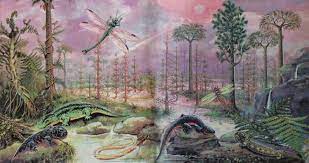
Carboniferous amphibians were diverse and common by the middle of the period, more so than they are today; some were as long as 6 meters, and those fully terrestrial as adults had scaly skin. They included a number of basal tetrapod groups classified in early books under the Labyrinthodontia. These had long bodies, a head covered with bony plates and generally weak or undeveloped limbs. The largest were over 2 meters long. They were accompanied by an assemblage of smaller amphibians included under the Lepospondyli, often only about 15 cm long. Some Carboniferous amphibians were aquatic and lived in rivers ( Loxomma, Eogyrinus, Proterogyrinus); others may have been semi-aquatic.